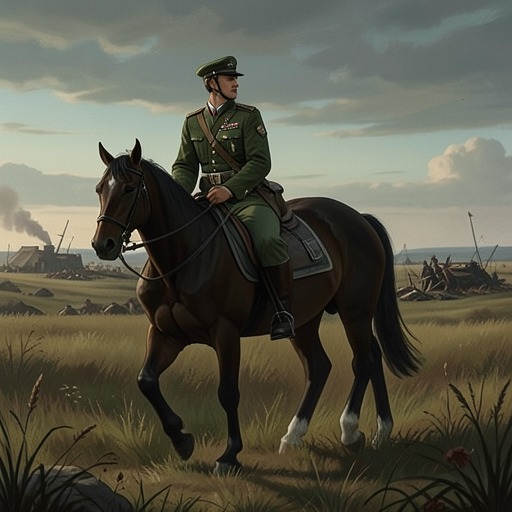
Captain’s Last Charge in the Crimean War
Black BeautyCaptain’s last charge in the Crimean War is the decisive battle in his recollection of military service: the day he lost the master he trusted and saw how few of the horses who went out with the cavalry returned. Told by Captain to Black Beauty, the episode begins with the confidence of a seasoned war horse and ends with survival shadowed by absence. Its account makes the charge more than a military action: it is the moment when loyalty cannot protect either horse or rider from the force of battle.
Before the Charge
Before this final engagement, Captain had taken part in many actions alongside his master without being wounded. He had seen horses fall and men brought down, but says he did not fear for himself while his master was guiding him. The rider’s encouraging voice had given him a sense of safety strong enough to carry him towards the enemy’s guns. That confidence matters to the scene: the battle breaks a bond that had seemed, to Captain, a dependable shelter.
The morning began before daylight, when the cavalry turned out ready for whatever the day required, whether fighting or waiting. As the light increased, the officers’ activity signaled that something was changing; before the day was well begun, the enemy’s guns could be heard. At the order to mount, the men and horses moved into position at once. The horses were eager, but their training held them nearly motionless, their readiness visible only in small movements.
Captain and his master stood at the head of the line. While the riders waited, the master noticed a stray lock of Captain’s mane lying on the wrong side, set it right, and smoothed it down. He then stroked Captain’s neck for longer than usual. Captain understood the gesture through his familiarity with the rider’s moods, and stood quietly because he knew that was what his master wanted. The tender adjustment of a mane, set against the imminent battle, gives the scene its intimate measure: even at the threshold of danger, their relationship is expressed through ordinary, practiced care.
The Cavalry Charge
The charge crossed a valley directly in front of the enemy’s cannon. Captain and the other horses had become accustomed to the noise of heavy guns and musket fire, but this advance carried them through a concentration of fire from the right, the left, and directly ahead. Men and horses fell, while some riderless horses ran out of the ranks and then pressed back among their companions, joining the movement towards the guns.
The formation did not turn back. As its numbers diminished, the remaining riders closed ranks, and their gallop quickened as they approached the cannon. Captain’s account emphasizes both the force of the advance and the discipline that held it together: losses did not stop the charge, and the line continued forward even as it thinned.
His master was encouraging the men with his right arm raised when a shot struck him. The rider’s sword fell and the rein slackened. Captain tried to check his speed and remain beside him, but the momentum of the other riders carried him away. That separation is the event’s central reversal. Captain had entered the battle confident that he and his master could not be killed while they were together; in an instant, he is moving with the charge without the guidance on which that confidence depended.
Alone on the battlefield, Captain tried to join the ranks, as other horses had done, but soldiers drove him away. A soldier whose own horse had been killed then caught Captain’s bridle and mounted him, taking him back into the advance. The cavalry company was eventually overpowered, and its surviving members galloped back across the same ground. Captain’s account thus moves from the forward pressure of the charge to a return through the place where the regiment’s losses had occurred.
Losses and Survival
After the battle, wounded men were brought in and the dead buried. The army farriers went over the field and put down horses they judged beyond recovery; horses with less serious wounds were brought back for care. Captain stresses the scale of the loss in terms of his own stables: only about one horse in four returned. The figure gives a concrete measure of the devastation without making Captain’s survival seem typical.
Captain never saw his beloved master again and believed that he had died when he fell from the saddle. The horse’s attempt to stay with him had failed, and the subsequent struggle to find a place in the ranks could not restore their partnership. Captain went on to take part in other engagements. He was wounded only once, not seriously, and returned to England at the end of the war as sound and strong as when he had left. His physical survival therefore contrasts with the permanent loss at the center of his story.
Meaning of the Recollection
Captain’s story is presented as a remembered episode within Black Beauty’s narration: the older horse pauses before telling it, and Black Beauty listens to the account. The frame gives the battle the authority of experience rather than spectacle. Captain does not describe the charge as an abstract display of courage; he recounts the master’s small gesture, the loss of the rein, the failed effort to remain at his side, and the depleted return. Those particulars keep the emotional focus on the horse’s relationship with his rider and on the consequences of battle for animals as well as people.
After hearing the story, Black Beauty observes that people sometimes speak of war as though it were glorious. Captain distinguishes that idealized view from exercises, parades, and sham fights, where no enemy is present and the cost is not apparent. In actual war, he says, brave men and horses are killed or left crippled. The last charge embodies that contrast: the regiment’s disciplined courage is real, but so are the deaths, the injured animals, the missing master, and the small fraction of Captain’s stable that returned. The episode makes survival possible, but not a victory untouched by loss.